

The presenting problem wasn't the REAL problem
When Central Hudson called E Source, the presenting problem was a $185 million arrears balance - up from $30 million over five years, touching more than a third of customers. It looked like a collections challenge.
It was something more fundamental.
For many customers, years of pandemic-era moratoriums had changed the relationship with the utility bill itself. What began as a temporary reprieve became a pattern: defer, ignore, disengage. By the time restrictions lifted, the amount owed had grown so large that re-engagement felt impossible. Customers weren't refusing to pay. They couldn't see a way back.
The financial problem, the relationship problem, and the regulatory problem were the same problem. Treating them separately is how utilities end up managing a crisis instead of a portfolio.
A perfect storm of compounding constraints
Central Hudson's recovery was unusually difficult for reasons beyond the arrears balance itself. COVID-19 moratoriums had run for nearly five years, atrophying collections capabilities at precisely the moment hardship was increasing. Simultaneously, a major SAP billing system implementation was underway - the utility had deliberately deferred collections functionality to focus on billing accuracy, a reasonable prioritization that nonetheless created a critical gap when collections pressure resumed.
The result: a utility that wanted to help customers get current but lacked the tools, data, and processes to do so effectively. Outreach was generic. Payment arrangements weren't consistently offered or tracked. And customers who had the capacity to re-engage weren't hearing from Central Hudson in ways that made re-engagement feel possible.
Diagnose before prescribing
E Source began with a diagnostic risk assessment - not a solution. The team needed to understand the full picture: the composition and trajectory of the arrears population, the state of Central Hudson's systems and processes, gaps in customer communication, and the regulatory environment shaping what was possible.
What the diagnostic revealed was a utility without a clear view of its own exposure. Arrears hadn't been stratified by segment, so there was no basis for prioritizing interventions. Outreach was uniform across customers with very different circumstances. And any process improvements needed to be compatible with a system still being built.
From that diagnostic came a phased strategy designed to operate within Central Hudson's constraints while building long-term capability:
- Phase 1: Strategy and roadmap. Current-state assessment, highest-leverage opportunities, clear action plan.
- Phase 2: Remediation and optimization. Manual outreach to priority segments, correction of data quality issues, optimization of existing collection efforts.
- Phase 3: SAP improvements. Alignment of SAP processes with collection strategy, automation of credit processing, contact center improvements.
- Phase 4: Credit risk transformation. Targeted outreach strategies, personalized servicing, sustained automation.
Rebuilding the relationship behind the bill
Collections performance is ultimately a proxy for customer engagement. A customer who trusts their utility and believes it's trying to help is a customer who pays their bill.
Central Hudson's outreach had become largely reactive and one-size-fits-all - uniform messaging that didn't account for individual circumstances, account status, or customer preferences. The shift to targeted, segmented outreach changed the dynamic. Messaging was matched to each customer's situation - first-time delinquents, customers at risk of disconnection, those with broken payment plans, financially-stressed households - and delivered through preferred channels.
The results made the case for digital channels clearly:
| Channel | Payment response rate |
| Text messaging | 48% |
| 31% | |
| Phone | 8% |
| Letters | 3% |
For customers facing genuine, persistent hardship, the strategy distinguished between those who needed a structured arrangement and those who needed a different kind of support altogether. Central Hudson continues to work on bill credit programs and other mechanisms to support customers facing structural affordability challenges.
Expert insight
"The utilities that struggle most with arrears aren't failing at collections - they're failing at diagnosis.
When we started working with Central Hudson, the arrears balance was the symptom. The real problem was that nobody had a clear view of who owed what, why they'd stopped paying, or how to reach them in a way that made re-engagement feel possible.
Once we stratified the portfolio, matched the message to the situation, and gave the organization the visibility to act on what it was seeing - the results followed quickly.
A 30% arrears reduction in five months isn't a collections story. It's what happens when you treat affordability as a risk management problem and build the cross-functional discipline to manage it that way."
Bob Cooke, E Source Executive Consultant
Results
Within five months of implementing the E Source strategy:
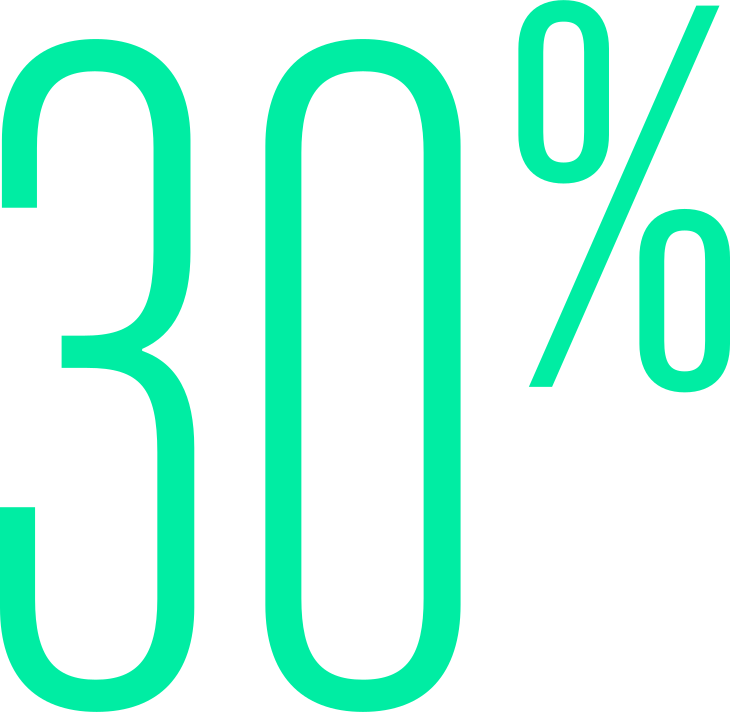
- 30% reduction in total arrears balances
- 2x increase in customers current on their bills
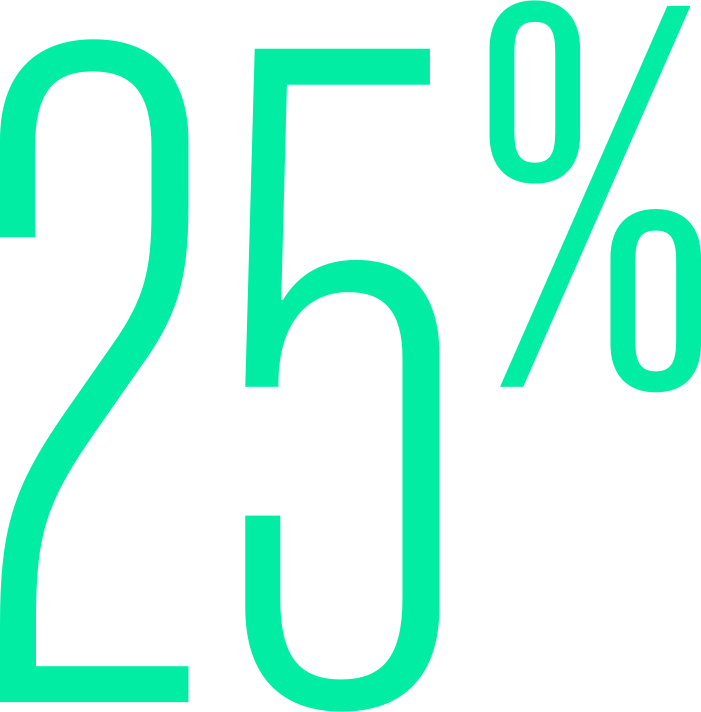
- 25% decrease in accounts in arrears
- 85% of new bills paid within 90 days
The results reflect something more than a collections recovery. The effort succeeded through senior leadership sponsorship, cross-functional collaboration, and improved performance visibility. Stratifying arrears by customer segment gave the team clarity to focus resources where they would have the greatest impact. Daily coordination across legal, regulatory, customer care, and finance teams helped remove obstacles and sustain momentum.
Learn more
To learn where your utility stands on arrears risk, visit go.esource.com/arrears.