
Reaching data centers with long-duration energy storage
The viability of long-duration storage in the US
About the author/s



LDES has long been a niche technology, making financial sense only in extreme edge cases like grid-isolated islands. But large, concentrated power demand of AI data centers has changed this, with data center growth outstripping both transmission capacity and natural gas turbine availability. LDES has shifted from a decarbonization bet into an immediate commercial necessity.
Economics that once made sense only at the margins, like Nantucket's isolated grid, now apply to the center of mainland power planning. Utilities that prepare now will be positioned to lead as LDES matures, and grid constraints tighten further. In this report, we look at the reshaped LDES market, the economics of effective load-carrying capability (ELCC), factors putting pressure on the timelines for US-made storage, emerging ownership and financing models, and the technologies competing for this emerging market.
The first island: Nantucket, Massachusetts, 2019
In 2019, Tesla installed the US’s first LDES battery on Nantucket, Massachusetts. It was an 8-hour, 6 megawatt (MW) system paired with 15 MW of diesel generators. It helped the island serve a growing and highly variable load from tourism, reportedly at half the cost of a new underwater transmission line. According to findings from the US Department of Energy’s (DOE) Energy Storage Valuation: A Review of Use Cases and Modeling Tools (PDF) the battery costs were $660 per kilowatt-hour (kWh) / $5,280 per kilowatt (kW)—expensive by today’s standards. The batteries couldn’t pay for themselves based on peak shifting, price arbitrage, or ancillary services. But by allowing the utility, National Grid, to delay expensive infrastructure upgrades, the batteries made good fiscal sense.
OEMs designed these batteries for resilience, so the batteries only needed to cycle about 150 hours per year. The economic model Pacific Northwest Laboratory details in the Energy Storage System Assessment: Final Report (PDF) for Nantucket provides key insights into the investment, highlighting how 75% of the system’s value came from deferral of transmission by 13 years.
Why LDES couldn’t compete elsewhere
A gas peaker plant would historically deliver around 20 MW of power at about $1,800 per kW (PDF), a price tag of about a third of what Nantucket paid. Nantucket’s isolation made it a unique case. LDES couldn’t pencil elsewhere in the US, where transmission was cheaper. Where transmission was available, natural gas would always be the first choice.
On the national level, LDES was very much a theoretical concept in 2019. Decarbonization was the driving logic for pursuing this technology. Analysts saw LDES as a necessary but expensive solution to extend renewables penetration beyond about 80% of system capacity in a large grid. But without carbon prices to force its use, future demand was pure speculation. Authors of the 2021 report Long-Duration Energy Storage: Policy Gaps, Regulatory Changes and Business Opportunities (PDF) stated there was, “Currently little need or value [for storage] beyond 4 hours.”
In practice, the only viable application for this technology was on Nantucket, where rapid increases in tourism had outstripped the capacity of the island grid. The long-term value of LDES was far from certain.
Data centers bring island conditions to mainland utilities
Fast forward to 2026: The demand for LDES has arrived, and the pattern is following the model of Nantucket. A rapid growth in demand for electricity has strained the transmission’s ability to deliver electricity. Most remarkably, it has strained the ability of natural gas generation as well. LDES is gaining traction because even the largest grids are now serving a patchwork of islands.
We can look to Virginia as a key example of this trend. Two pieces of legislation created one of the largest storage mandates in the country, requiring 16 gigawatts (GW) across Dominion Energy and Appalachian Power by 2045, including 4.5 GW specifically for long-duration resources. The state is hedging on execution, as the State Corporation Commission must run a demonstration program and confirm the technology is viable by 2031, but the targets sit in statute rather than waiting on each project to prove out on its own.
For data centers, the value of power is measured in time. LDES isn’t catching up to transmission just because of lower costs, though system costs have indeed dropped thanks to technical scaling and generous tax credits. Most important is the transmission line that’s otherwise not available. For utilities and developers deciding where to put their attention, the island’s analogy is a useful one to hold onto: The economics that once worked only at the edges are moving to the center.
The players who learn the rules of LDES first will be the ones ready when the grid gets tighter still.
How data centers are powering up
The sums stakeholders are committing to data center construction are vast. According to construction data from the US Census Bureau, spending on data center construction outstrips spending on office construction ($50.7 billion versus $43.8 billion at a seasonally adjusted annual rate in April 2026). Total spending on data centers (including chips and IT), which was projected at between $580 billion and $770 billion in 2025, has caught up to total spending in the oil and gas or renewables infrastructure.

These data centers need power. A state-of-the-art B300 Nvidia graphics processing unit (GPU) consumes 1.4 kW of electricity at peak load. A rack of 72 GPUs consumes up to 155 kW at peak, including cooling. A data center may contain thousands of racks. Next-generation chips will push this further. Nvidia’s upcoming Rubin Ultra is expected to draw about 600 kW per rack. The following generation, Feynman, will likely exceed 1 MW.
The preferred path: Interconnection
The preferred choice for standing up these new loads will always be to connect the data center to a utility. From a management perspective, data centers would rather outsource power provisioning and reliability engineering than build those competencies themselves. Financially, the data centers stakeholders would rather that the investment in power generation show up on someone else’s books: the capital expense sits easier on a utility’s balance sheet demanding an internal rate of return (IRR) of less than 10% than on a data center’s balance sheet demanding an IRR of 15%–20%. The cost of new interconnections varies widely, but we can roughly price a new large load at about $1,000 per kW, so a GW data center could plausibly have a $1 billion interconnection bill. A modern data center will have a total all-in capital expenditure cost of roughly $40 billion–$50 billion per GW ($50,000 per kW).
An AI data center can generate over $100 billion per year per GW in revenue annually when selling API inference on the latest gneration of GPU. In the next few years, both the cost and revenue per GW could reasonably double. Interconnection costs aren’t large in the context of the total business, so data centers typically prefer interconnection when they can get it.
When interconnection can’t keep up
Interconnections aren’t readily available and queues for interconnection stretch for years. National growth in demand has outstripped the ability of the grid to adapt, just as in Nantucket, and the money isn’t waiting.
One solution is behind-the-meter (BTM) generation, either to serve the full data center load or (preferably) to stand up a load quickly while utilities build new substations. X.ai (now SpaceX) pioneered this strategy when it originally (and controversially) stood up operations for its Memphis, Tennessee, data center using hundreds of MW mobile natural gas turbine capacity. The company has since supplemented that with hundreds of MW of interconnection to the Tennessee Valley Authority’s grid, while the total data center size continues to grow.
BTM is more expensive than an interconnect, and the workhorse generators are integrated gas turbines and fast-ramping aeroderivative units. These are less efficient than the combined-cycle turbines utilities favor, and their cost is higher as well, upward of $2,000 per kW. When they’re available, these gas turbines are the preferred BTM solution, but gas turbines are no longer readily available.
The data center boom has saturated the production capacity of turbine manufacturers. For example, GE Vernova has almost sold out its 2029 capacity and is taking orders for 2031. Natural gas fuel cells have risen in popularity simply because they’re immediately available at $3000–$4000 per kW, despite typically having higher operations and maintenance costs thanks to solid oxide fuel cell stacks that operators must be swap out every five to six years.
In the end, developers claim whatever grid power they can get. Where that power isn’t firm, they pair it with BTM peakers to cover the gaps, and they run the two together to support a larger site than either could carry alone. Size and speed matter more than cost.
LDES manufacturers have watched and are set to benefit from this need for energy. Prices are up, competitors can’t serve demand, and the niche that LDES is best suited for—balancing supply in a constrained grid—has gone from imagination to an immediate need.
ELCC: Why LDES is hitting the market
Operators design a data center to operate as a base load system—busy 24 hours a day, 7 days a week, for 365 days a year—to maximize its return on capital expenditure. Most are fully utilized today. As capacity catches up with demand, data center load will show the time-varying patterns utilities know well, BTM or on the grid.
The question for data center operators is the same as for utilities: How will they balance loads, within a single day, across a long weekend, and throughout a season?
OpenRouter token usage by day
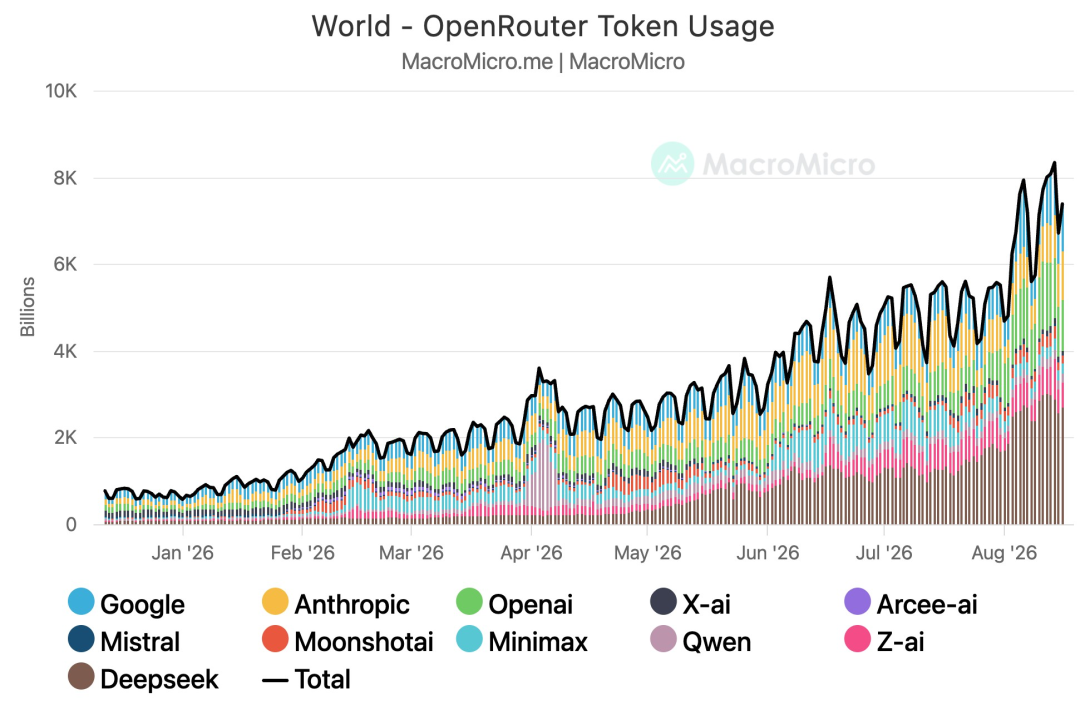
But the economic stakes are high for data centers, and this will lead to changes in the technological landscape. A data center operator has paid for its capital expenditure, and (with 2026 economics) can generate over $100 billion per year per GW in revenue from that installed base. All other things being equal (a big assumption in this fast-moving field), each kWh consumed generates over $10 in value—a number that should rise as compute efficiency improves.
The potential value of load shifting has suddenly grown by an order of magnitude relative to the cost of generation, if it increases system uptime. To evaluate possible solutions, we need ways to measure not just the power contribution of a resource but its availability.
ELCC in practice
This measurement exists in the world of utilities: the ELCC. ELCC is the share of its rated capacity that contributes to reliability when the system is stressed. ELCC isn’t simply a measure of how often a resource is available, it estimates how much firm, always-on capacity the resource is worth for reliability planning.
For example, for natural gas, pipelines are always ready to serve fuel, and ELCC is 80% for a combined cycle turbine, representing its highest availability at any duration. For storage, ELCC depends heavily on duration. It doesn’t help the grid to add more four-hour storage to a system whose peak extends for six hours.
In its blog What ELCC is Telling Us About PJM’s Capacity Crunch, PJM Interconnection, the largest US grid operator, accredits:
- A 4-hour battery at roughly 58% ELCC for the 2027 / 2028 delivery year
- An 8-hour system at about 70% for the 2027 / 2028 delivery year
- A 10-hour system at about 78% for the 2027 / 2028 delivery year
Translated into revenue, the same nameplate MW in PJM earns materially more as duration grows—about $70,000 per year at 4 hours versus roughly $84,000 at 8 hours and more than $94,000 at 10 hours at December 2025 capacity prices.
Data centers are pulling LDES forward
While not every grid operator uses the same formula for ELCC, and ERCOT notably doesn’t reimburse ELCC directly at all, the spirit of this valuation methodology transfers to private contracts. A data center operator will make a tolling arrangement with an LDES developer, which effectively compensates it for duration of capacity, so the data center can run reliably or its system can effectively integrate with the grid. If a data center needs an LDES installation to secure a license to operate, it will find a way to pay.
This trend will intensify. As more short-duration storage joins the system, the reliability need it serves fills up, and the marginal ELCC of the next four-hour battery declines. Analysts at Evolved Energy Research expect new additions of four-hour storage to fall below 40% ELCC as deployment grows. The duration required to hold a high capacity credit keeps rising, and we should expect LDES penetration to rise with it.
The old assumption circa 2024 was that utilities would gate LDES penetration by their ability to reward it. The new assumption is that each data center acts as its own utility, its own balancing authority, and its own market. Fully BTM data centers face less exposure to supply variability, though they still must manage swings in their own demand, a task in-house software controls can help absorb. If the benefit exists, private markets will find a way to pay for services that the grid is only just learning to put a price on.
US tax credits: Why new LDES systems may not be lithium
For US-produced LDES, there is an added bonus on top of market forces. The Inflation Reduction Act of 2022 created a class of US government subsidies called the Section 45X Advanced Manufacturing Production Credit. This credit pays US battery manufacturers $35 per kWh for the battery cell plus $10 per kWh for the module—$45 per kWh for a complete domestically-made battery. This subsidy goes to the battery manufacturer and with the goal of lowering its list price to make a battery installation more affordable. The credit begins to sunset after 2029, dropping to 75% of its original in 2030, 50% in 2031, and 25% in 2032 before fully expiring.
On top of this first credit, the project owner (a developer or utility) can take advantage of the Section 48E Clean Electricity Investment Tax Credit, a 30% credit based on the project’s capital expenditure. This adds another 10% if the project uses domestic content, plus a further 10% bonus for building in specific areas. And on top of that, the owner can also expense the asset in year one, a savings equivalent to another 2%–3% of the project’s net present value. The staggering of the two credits shapes how the wind-down will feel. The 45X manufacturing credit falls 25% a year from 2030, and, because 48E steps down on a similar but later schedule, some subsidized demand persists after the manufacturing credit has largely rolled off. If manufacturers have used the window to bring costs down at scale, the step-down should land softly rather than abruptly. And neither schedule is settled since US Congress could extend either credit. These credits mean a developer can build a storage project at roughly half price, depending on the non-capital expenditure costs associated with development.
The 45X and 48E will support any domestically manufactured storage, including conventional lithium-ion. The tax credits are particularly advantageous to emerging LDES technologies, especially multiday storage, since these technologies typically use very cheap storage media, so manufacturers who deliver on their cost reduction claims could literally give away capacity and make a profit (installing that capacity would still cost money, of course). Data center demand, natural gas turbine shortages, and the tax code are all pushing US energy storage companies to both extend duration and accelerate their shipment schedules to deliver by 2029.
Under these conditions, we should expect growing interest in LDES deployment. We’re beginning to see the first signs of this in the market today.
Who owns the storage
So far, we’ve discussed LDES as something a developer builds and a data center pays for. That’s the fastest path to deployment, but it’s not the only one. The chosen path determines who captures the credits and who carries the risk.
Four ownership models:
There are four main options:
- The customer owns the LDES behind the meter, which is quickest and keeps the asset off the utility’s books. The trade-off: The utility lacks direct control of the asset. From the customer's standpoint, the trade-off is that they need all the expertise in-house. It’s not their core. It distracts from their main business.
- A developer owns the LDES under a tolling agreement with the data center, which is the dominant construct today and the one substituting for a missing capacity market.
- The utility owns and rate-bases the LDES. This is the only structure that spreads the reliability benefit across the whole system.
- The customer funds the LDES, and the utility owns it. It has a tariff moving the incremental cost to the party that wanted the asset.
This final option is the structure Google built with NV Energy as the Clean Transition Tariff (CTT). This was approved in Nevada in 2025 to fund 115 MW of enhanced geothermal. It’s now funding the largest LDES project announced to date: Xcel’s 300 MW / 30 GWh Form Energy system in Minnesota. This system also draws its financing from a variation on the same tariff, alongside 1.4 GW of wind and 200 MW of solar.
Georgia Power’s Customer Identified Resource Program, approved in April 2026, does something similar at smaller scale. It lets a large customer propose and fund a project the utility then contracts for and delivers, with the customer taking bill credits in return.
Planning implications:
For utility planners and large load or battery program teams, the key takeaway is that the tariff model is replicable but takes time to stand up. Similar approaches are already under discussion or development at Duke Energy in the Carolinas, Entergy Arkansas, Ameren Missouri, and elsewhere. It took a year to Nevada to get approval, which gates the ability to kick off customer agreements, project development, and energization. Utilities that wait until 2027 or later to begin the process could find themselves trying to get projects online as the tax credits are stepping down.
The technology field: Same job, different edges
From the perspective of the data center as of mid-2026, the key attributes of LDES are the ability to serve load reliably and come online by 2030 when bottlenecks in natural gas generation capacity may begin to alleviate. But if power can come earlier than 2030, then there will be interested customers.
The useful way to compare technologies isn’t just on dollar per kW or dollar per kWh alone; it’s also on time to market, risk, and any unique services they provide. Below, we provide a brief overview of solutions, starting with lithium-ion and then progressing to emerging LDES competitors.
LDES technologies split into two duration tiers
| Technology | Duration in hours | Domestic | Power / energy decoupled | Largest constructed LDES projects (ex-China; more than 8 hours) | Largest announced LDES project (ex-China) |
|---|---|---|---|---|---|
| © E Source (compiled from multiple sources). Notes: LDES = long duration energy storage; MW = megawatt; MWh = megawatt-hours. | |||||
| Lithium-ion | 4–8 | Varies | No | 125 MW | 300 MW |
| Energy Dome | More than 8 | Yes | Yes | 20 MW | 200 MW |
| Vanadium redox flow | 4–more than 8 | Yes | Yes | 3 MW (20.7 MWh paired with 3 MW of solar; battery power not separately reported) | 108 MW |
| Form Energy | 100 | Yes | No | None fully operational | 300 MW |
| Noon Energy | 100 | Yes | Yes | None fully operational | 25 MW |
Note that not every hyperscaler (traditional data center operators, such as Amazon, Google, and Microsoft) or neocloud (newer, AI-focused data center operators, such as CoreWeave, Lambda Labs, and Crusoe) will share the same stance toward storage.
Amazon, a company built on standardization and scale, has plans to access conventional four-hour battery energy storage systems as part of a utility power deal, but it hasn’t published anything about LDES publicly. Google, famous for experimentation, is developing both eight-hour and multiday storage in collaboration with utilities. Crusoe has grown quickly by developing bring-your-own capacity (BYOC) that replaces the function of utilities entirely, and it seems to be building the in-house expertise needed to take greater risks.
The energy industry has historically moved slowly, and that should remain the base expectation. But experiments are starting.
Lithium-ion’s role in LDES. California just turned on the US’s first large-scale eight-hour battery, built by derating existing four-hour systems. As a stand-alone eight-hour system, the economics are marginal with US-installed costs running around $200 per kWh, but this price could fall depending on the future of anti-China tariffs. This first large contract used batteries from Chinese manufacturer BYD, and state and federal incentives underwrote it. Lithium-ion LDES is more competitive abroad than it is in the US, as four-hour battery energy storage system (BESS) prices have dropped to just $75 per kWh for an AC battery container and an installed cost of $125 per kWh at utility scale. This translates to a levelized cost of storage of just 6.5¢ per kWh, which would enable a solar energy system coupled to an eight-hour battery to deliver energy through the day at sub-10¢ per kWh. Such pricing isn’t yet attainable in the US, but further cost reductions are coming.
An LDES-optimized battery system would be cheaper than existing four-hour BESS because lower power operation leads to less internal heating during charge and discharge. Chinese lithium-iron phosphate vendors are moving to larger cells and simpler container designs for LDES. According to reports from PR Newswire’s, Hithium, China’s second most prevalent BESS provider, has unveiled an “8-hour-native” 1,300 Ah cell that’s about four times the size of a standard cell. Larger cells and a reduction in cooling equipment lead to more dense containers as well. We expect a $10 per kWh cost reduction at the container level for LDES, relative to four-hour installations.
Global outlook. Globally, the lithium LDES case is strong. Australia has recently built the country’s first 8-hour battery. In the UK, even 16- and 18-hour lithium-ion BESS projects have made the short list for investment under the control of a new LDES authority, though they’re still far from coming online.
Lithium is the leading technology based on its field history, bankability, and high round-trip efficiency. In the US, for tax and tariff reasons, we expect non-lithium technologies to get a closer look, as we describe below.
Of the emerging non-lithium players, Energy Dome is among the most advanced. Its first commercial-scale plant, a 20 MW / 200 megawatt-hour (MWh) facility in Sardinia, Italy, has supplied power to the Italian grid since 2022.
Energy Dome’s key projects. The company has built a substantial pipeline:
- A 20 MW / 200-MWh project with Alliant Energy in Wisconsin
- A 19 MW / 200 MWh project in Arizona with SRP (backed by Google)
- A 23 MW / 200 MWh project in Ireland with Google
- A memorandum of understanding to support a 1-GW data center in Odessa, Texas
To capture the full tax credits, a separate energy development company funds projects, which toll back to a private user like a data center.
Energy Dome. Energy Dome’s edge is that it’s relatively inexpensive to add capacity. Energy Dome designs power and energy independently. It stores energy by compressing carbon dioxide to a liquid and releases it again to depressurize to a gas. The expanding gas generates power by running through a turbine as it exits its tank.
Because the tank is relatively inexpensive, the $45 per kWh tax credit will bring down the marginal cost of adding duration. In the extreme, if Energy Dome could produce its tanks and piping at less than $45 per kWh, tax credits would incentivize it to give away duration. This hasn’t happened, but it represents a useful indication of why the tax story favors emerging domestic technology, at least until the end of 2029.
Energy Dome’s system provides real, synchronous inertia, which is the instantaneous, physical resistance to frequency change that a spinning generator delivers and that inverter-based batteries approximate. As conventional generation retires and data centers connect at weak points on the grid, native stability may become more valuable, though inertia remains difficult to monetize through any consistent market mechanism as of mid-2026.
First developed in the 1980s, vanadium redox flow battery (VRFB) technology stores energy in tanks of its vanadium-containing electrolyte. The system stores the electrolyte separately from the power conversion device, so a developer theoretically can extend duration simply by enlarging the storage tank. Again, the structure of the 45X tax credit favors this architecture for LDES, though the market value of the vanadium metal in the electrolyte is certainly above $45 per kWh.
Field experience. Flow batteries have a growing track record in operation, and a growing body of field data from system and component manufacturers, including Storion, Cellcube, Sumitomo, and Invinity, to instill confidence in prospective customers. Sumitomo has had an operational 15 MW, four-hour installation in Japan for over 10 years. China has three installations at least 100 MW. Invinity recently won a contract to design a 1.5 GWh redox flow battery at a data center in Switzerland.
The data center opportunity. Despite the obvious architectural advantages that VRFB offers for LDES, most installations (like the GW-scale battery in Switzerland) have been for conventional durations. These applications take advantage of the vanadium electrolyte’s unique durability: the electrolyte doesn’t degrade, even under continuous full-power cycling. This creates the ability to cycle multiple times a day at high ramp rates.
Historically, few applications needed to use this capability, but data centers might, as a lithium battery system will overheat under sustained duty, degrading its service life. Meanwhile a VRFB should remain stable. A VRFB can provide a kind of “data center ancillary service” (continuous power conditioning) while also serving as long-duration storage. Manufacturers can also build VRFB on a supply chain compliant with tax credit eligibility.
The key challenges. The open questions are readiness and integration. The exact architecture will depend on grid conditions and on the data center’s power-conditioning needs—which evolve with chip and cooling design. And there’s an important risk distinction between relying occasionally on a new technology during peaks and relying on it to continuously smooth power for an entire data center.
Insurers have shown appetite to back vanadium flow as a load-shifting system. But continuous power conditioning is a newer application that will need its own validation and coverage.
A separate segment is emerging for multiday storage with a very different value proposition and operating conditions than conventional four- or eight-hour batteries. Form Energy is the best-known company in this segment, developing a 100-hour, iron-air battery using inexpensive iron metal as an anode material and oxygen in the air as a cathode. Noon Energy is pursuing a similar strategy, and has developed a carbon-oxygen battery, again featuring an exceptionally low-cost anode with air as a cathode.
Commercial interest is growing well ahead of deployment. Form Energy raised another $750 million in August 2026, bringing its total equity funding to more than $2 billion, and its project backlog has also grown from 20 GWh to 80 GWh. That level of investment and contracting is particularly notable for a company that hasn’t yet begun commercial shipments at scale.
The technology still has a lot to prove. No one has scaled the chemistry before, and its cycle life is unproven. But a 100-hour battery shouldn’t need anywhere near the durability of other forms of LDES because manufacturers design them to cycle monthly, rather than daily, so they might get away with less than 300 cycles over their entire capital life.
Much of the recent demand is coming from data centers. Form Energy&rsquos first 1 MW pilot for utilities and is under construction in Minnesota. Google has pledged about $1 billion to Form Energy and reserved 30 GWh of 100-hour iron-air capacity for a Minnesota data center, while Crusoe contracted an additional 12 GWh for AI data centers. Meta has reserved up to 100 GWh from Noon Energy. Investors and customers are effectively betting that growing demand for firm capacity will create a role for storage capable of covering multiday reliability events.
Form’s contract with Google implies a cost to Google of $33 per kWh and substantially more revenue to Form Energy once federal manufacturing incentives are included. Form originally targeted a $20 per kWh cost basis. The 45X manufacturing credit could be particularly important to the economics. Eligible battery cells can receive up to $35 per kWh of capacity with additional support available for qualifying modules. In other words, the federal manufacturing incentive alone could exceed Form Energy’s original targeted manufacturing cost.
The next hurdle is execution. It’s unclear whether Form Energy or Noon Energy can produce such large volumes before manufacturing tax credits begin to expire at the end of 2029, or project tax credits expire at the end of 2033. The economic model for a multiday battery is unproven, and the US DOE heavily subsidized the pilots to date. But as with LDES, data center operators have shown their interest without the need to build a rate case and well ahead of proof of scale or bankability. Realistically, we should read these announcements as a bet: A hyperscaler diversifies its supply base to protect against the possibility that gas supplies remain constrained or a carbon price emerges.
The difference for utilities. That logic works in the data center world where each marginal available kWh might reasonably be worth more than $10 in revenue and the notion of spending a billion dollars on an option for future supply may make financial sense. This logic doesn’t translate to utilities that would be committing to an unproven technology at scale for a factor of 100 less revenue. This would also be happening in an industry that’s much more sensitive to risk.
Recovering the cost of a first-of-a-kind, unproven technology from its customers is hard for a traditional utility to justify. Private tolling agreements are one answer, and a small number of utilities are now using customer-funded tariffs like the Clean Transition Tariff to solve the same problem without a rate case. Where neither exists, utilities need partners such as developers and offtakers willing to carry early risk to validate these systems.
The proving ground: What first-of-a-kind technology must demonstrate
Whatever the chemistry, an early-scale LDES project must clear a consistent set of gates before a utility will sign off or a developer can finance it:
- Reliability and grid sign-off
- Interconnection
- Power quality and inertia
- Development as a moving target
- Insurability and bankability
A utility needs to see performance under fault conditions, real availability data, validated models, and operating history before it approves a novel system. This is where an operating reference plant, like Energy Dome’s facility in Italy, does disproportionate work: It converts a specification into evidence.
Reliability sign-off shows the technology works, but interconnection asks whether the utility can call on it operationally. For projects that require a grid interconnection, and in LDES, developers usually install projects to buffer the grid. The utility must believe that the technology is stable and will respond on demand.
The distinction between real and synthetic inertia may become material when interconnecting these numerous large loads. Rotating-machinery LDES supplies physical inertia natively; inverter-based lithium supplies synthetic, grid-forming inertia through controls; and vanadium flow can add continuous power conditioning. These differences may affect interconnection study timelines and the value a resource can offer.
Data centers have historically required very high availability, commonly 99.98% or higher. This reliability comes at a price, relying on banks of rarely-used diesel gensets as backup.
It’s possible to develop software-based alternatives that let the data center ramp down or turn off entirely, which may be less expensive. Meta stood up its most recent data centers without using diesel at all, dropping its uptime to just 99%. The industry is in flux, and it isn’t clear that old definitions of reliability are still meaningful.
Underneath the headlines of contracts for new technologies, a considerable amount of work remains. Well-funded startups self-insure their first installations and often work with project finance investors to fund first-of-a-kind plants. These specialist investors require several points of return above a baseline energy project to justify the technology and execution risk they take. Whether this model scales to gigawatt-hours, and how much of that risk hyperscalers ultimately carry, will determine when the first electrons actually deploy.
What it means for developers, utilities, and markets
For developers
The path is about sequencing and speed. Technologies like Energy Dome can hit the grid in 24 months, and speed provides attractive economics. The distinctive attributes of emerging technologies—native inertia (rotating mass that resists sudden shifts in grid frequency), continuous slew (the ability to ramp output smoothly across the full operating range rather than in steps), or sheer duration—may also attract enough interest to justify the higher risks associated with first-of-a-kind projects. These timelines reflect vendor claims rather than independently verified manufacturing throughput and are worth revisiting as pilot plants move from construction to full production.
Most importantly, tax credits provide incentive to take possession of new LDES equipment before the end of 2029 if possible.
For utilities
LDES is moving from a technology to watch to a competency to bid with. The more constrained the grid becomes, the more duration matters and the more a utility's facility with it becomes a differentiator rather than a nicety.
Know where LDES is the best option. The case for LDES isn’t always that it’s cheaper than a gas peaker. In some locations, gas simply may not be available on the timeline a utility needs. A new pipeline may be difficult or impossible to permit, as in Nantucket; turbine procurement can stretch project timelines; and new fossil generation will become harder to justify as utility, state, and customer decarbonization targets tighten. In those cases, the relevant comparison isn’t storage versus an available peaker. It’s storage versus a peaker that stakeholders can’t build, fuel, or permit in time.
Utilities should identify these constraints before they become urgent. Areas with limited gas infrastructure, long equipment lead times, difficult permitting, or binding emissions targets are the places where longer-duration storage may become a practical capacity resource first.
Set the ownership and tariff structure early. A new large load customer arriving with its own storage may not fit neatly within existing standby, backup-power, or interconnection rules, many of which were designed around diesel generation rather than large batteries. Utilities should decide in advance how they’ll treat customer-owned storage, what services it can provide, and who controls it during constrained periods.
Evaluate the vendor as closely as the technology. For many LDES projects, the largest commercial risk may be the manufacturer rather than the underlying technology. Utilities should look beyond performance claims to manufacturing capacity, warranties, their balance sheet’s strength, project pipeline, and who ultimately carries replacement or performance risk if the supplier fails.
Use early projects to buy down risk. Pilots and codeveloped projects can help utilities build operating experience while developers, customers, or public funding still absorb part of the first-of-a-kind cost. The eight-hour segment may be the most practical place to build that experience now. The segment is closer to conventional utility storage applications, while hyperscalers that see technology risk as an acceptable route around the risk of supply chain bottlenecks are driving much of the earliest demand for 100-hour systems.
For markets
The data center wave may bring new products into existence. Data center developers are pioneering constructs that price duration more explicitly, tolling structures that substitute for missing capacity markets, and stability or power-conditioning services that, as of mid-2026, have no clean revenue line. These shifts should be durable, and private contracts will pave the road for regulated markets. New LDES solutions that use the tax credits before 2029 may scale enough to be market-competitive after the credits expire.